
Modern organizations produce more data than at any other point in their history. They collect feedback from customers, monitor operational performance, track digital behavior, conduct research studies, build journey maps, and commission surveys that promise to reveal the state of the customer experience. In principle, this abundance of evidence should make improvement easier. With so much insight available, organizations should be able to pinpoint friction, understand its causes, design targeted interventions, and confidently implement solutions.
Yet this is not what happens. In many organizations, insight accumulates without producing the intended change. Reports circulate. Dashboards are updated. Customer sentiment is tracked with precision. But the translation from evidence to meaningful, system level improvement remains slow, inconsistent, or superficial. Leaders often find themselves asking a familiar question. If we know so much, why does the experience feel the same.
This question is not unique to any industry. It appears in aviation, healthcare, retail, finance, public services, and mobility. It appears in organizations with sophisticated analytics and in those just beginning to build experience capability. The persistence of the problem suggests that it is not a matter of tools or maturity of methods. It is a structural issue. The challenge is not that organizations lack insight. The challenge is that insight does not map neatly onto the system that produces the experience.

Understanding why insight fails to create action requires examining the nature of modern service systems. These systems are not linear. They are networks of interconnected processes, policies, technologies, and decisions. Each part influences the others. Each part relies on shared assumptions. Each part has its own constraints and priorities. When insight enters this environment, it must compete with many other forms of information that shape how people interpret and prioritize change.
In many organizations, insight is produced in isolation from the operational structures it is meant to inform. A research team may uncover a pattern of customer confusion, but the ownership of the root cause may lie across three or four different functions. A survey may reveal frustration with digital onboarding, but the source of the frustration may sit in regulatory interpretation or data architecture rather than in the interface itself. A journey map may show emotional peaks and dips, but the dips may originate in back end systems or scheduling decisions that do not fall within the authority of the journey owner. Evidence describes what customers experience. It does not automatically reveal the system interactions that cause it.
This separation between surface insight and underlying structure is one of the primary reasons that action stalls. Organizations often assume that identifying friction is equivalent to identifying the cause. But in complex systems, causes are distributed. They arise from multiple interactions, not from single points of failure. Without understanding how the system behaves, insight remains descriptive. It can explain what is happening, but not how to change it in a way that endures.
Another barrier emerges from the way organizations make decisions. In environments with competing priorities, insight must contend with operational targets, regulatory expectations, financial constraints, risk assessments, and technology roadmaps. These structures influence what improvements are considered feasible. Even when an insight is accurate and compelling, it may not align with the constraints of the moment. Teams may know what needs to change but lack the authority or resources to make that change. Insight without ownership becomes a form of organizational noise. It is acknowledged, circulated, and sometimes admired, but it does not progress toward implementation.
There is also the issue of interpretation. Different teams may interpret the same insight in different ways. What looks like a problem of service quality to one group may appear to another as an issue of process flow. What one team sees as a messaging misalignment, another may see as a technology limitation. Without a shared method for interpreting evidence, insight becomes fragmented across the organization. Each team sees only the part that relates to its own function. This fragmentation makes coordinated action difficult. Improving one segment of the system may have little effect if other parts operate in ways that contradict or dilute the improvement.
Even when organizations are aligned on the interpretation of evidence, another challenge often arises. Insight tends to focus on conditions experienced by customers, but improvement requires altering the behavior of the system. This means changing routines, decision logic, information flows, governance structures, policies, or technological pathways. These elements are often deeply embedded, and changing them requires coordinated effort. Many organizations underestimate the scale of this task. They assume that a clearer customer insight should naturally lead to a straightforward operational adjustment. In reality, translating insight into system level change is closer to restructuring a mechanical assembly while it is running at full speed.
This is why organizations frequently attempt to solve experience problems through surface interventions. They modify touchpoints, adjust scripts, retrain staff, or update communications. These actions can create short term improvements. They can also create the illusion of progress. But if the underlying system remains unchanged, the improvements degrade over time. The system behaves as it did before, and the old patterns reemerge. The organization then gathers new insights that confirm the persistence of the issue, and the cycle continues. Evidence accumulates. Action remains partial.
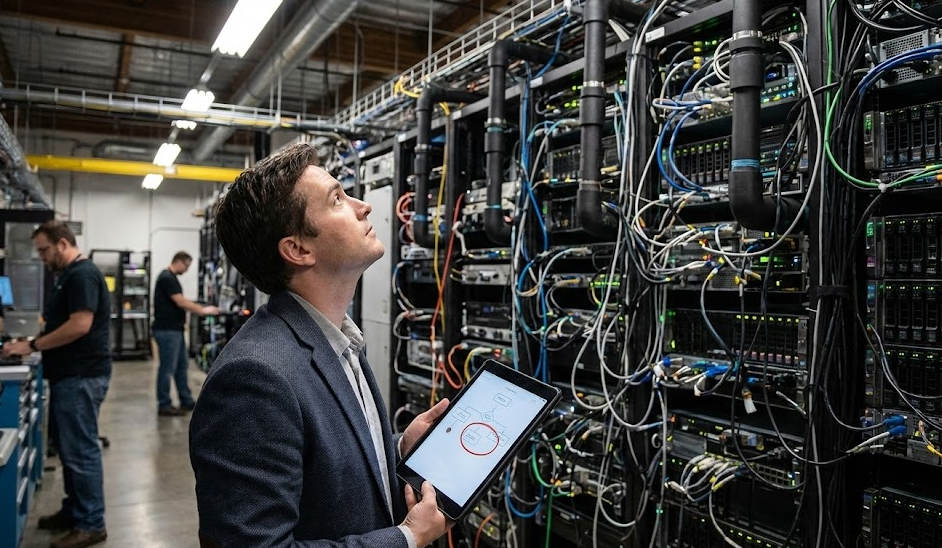
At the heart of this dynamic is a simple truth. Experience is a system output. Insight that describes the surface of the experience does not automatically reveal the deeper system that produces it. For organizations to turn evidence into meaningful improvement, they must understand how the system behaves and how to influence that behavior in a sustainable way. This requires shifting the focus from isolated insights to the capabilities that allow those insights to be interpreted, aligned, refined, integrated, and measured across the organization.
When organizations adopt this perspective, insight begins to take on a different role. It becomes the starting point for structured inquiry rather than the end of a research cycle. Instead of asking what the insight says, teams begin asking why the pattern exists, how the system contributes to it, which actors hold responsibility for different parts of the cause, and what kind of improvement would address both surface friction and underlying structure. Insight becomes a catalyst for sensemaking. It brings teams together to interpret evidence, share perspectives, and understand the operational and emotional implications of the problem. In this environment, insight has a pathway to action because its meaning is collectively shaped and collectively owned.
Once priorities are established, the challenge becomes designing solutions that are operationally feasible. Many organizations attempt to design improvements that reflect the ideal experience rather than the realities of their systems. They develop concepts that look compelling in a workshop but falter when confronted with regulatory requirements, staffing models, technology constraints, or interdepartmental dependencies. When solutions fail in implementation, the organization often returns to gathering more evidence, believing that the insight was incomplete. In reality, the issue was not the insight but the lack of system aware refinement.
Meaningful improvement requires translating insight into solutions that align with the constraints and capabilities of the system. This is where operational, technological, and governance perspectives become essential. If the design does not acknowledge the realities of how work is actually done, it cannot be integrated into the system in a reliable way. Organizations that succeed in turning insight into action understand that refinement is not an aesthetic exercise. It is a process of aligning desired outcomes with feasible execution.
The next step is integration. Even strong solutions fail when they are not embedded into the operational fabric of the organization. Integration requires attention to process updates, role definitions, technology configurations, training, communication, and ongoing governance routines. It requires clarity about ownership and accountability. It requires coordination across functions that may not typically work together. Without these elements, improvements remain isolated pilots that cannot be scaled or sustained. This is another point where many organizations fall short. They underestimate the discipline required to turn a concept into a stable component of the experience system.
Finally, organizations must measure the impact of the improvement in a way that reflects system behavior. Traditional experience metrics often focus on sentiment or perception, but these indicators may not reveal the operational dynamics behind the change. Meaningful measurement requires understanding whether the system behaves differently, whether variability has decreased, whether emotional stability has improved, and whether the underlying contributors to friction have been addressed. When this type of measurement is in place, organizations learn from their improvements, refine their approach, and strengthen their capability to act on evidence in the future.

The struggle to turn evidence into meaningful experience improvement is not a failure of motivation or intention. It is a structural challenge that arises from the nature of modern service systems. Evidence describes surface experience. Improvement requires altering system behavior. Bridging this gap demands a coherent method, shared interpretation, cross functional alignment, operationally grounded refinement, disciplined integration, and measurement that reflects system performance.
Organizations that develop these capabilities transform their relationship with evidence. Insight becomes actionable. Improvements become sustainable. The experience becomes more coherent, more predictable, and more emotionally stable for customers and employees. Most importantly, the organization begins to operate experience as a system rather than as a set of disparate touchpoints.