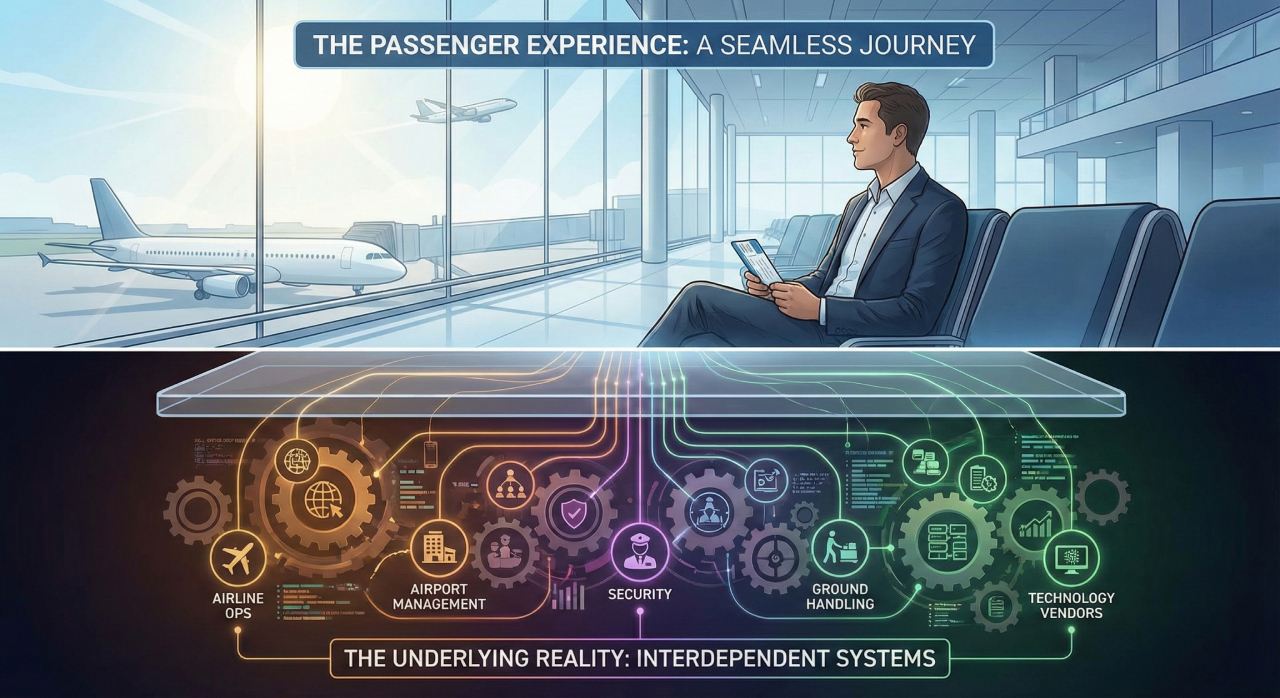
Air travel is one of the most intricate service environments in the modern world, yet for most travelers it feels like a single, continuous experience. A passenger arrives at the airport, navigates a sequence of steps, reaches the gate, boards an aircraft, and later exits into another environment that appears to follow the same logic. To them, it is a journey delivered by a single entity with a single intent. In practice, however, this journey is constructed by a wide constellation of organizations, each with its own mandates, constraints, operational pressures, and technological infrastructures. The veneer of simplicity masks a far more complex reality beneath the surface.
This complexity shapes every aspect of the travel experience. What feels to passengers like a straightforward sequence of touchpoints is actually the product of many interdependent systems that interact in real time. The way these systems align or misalign determines not only operational performance but also the emotional stability of the traveler. When the underlying system behaves predictably, the experience feels smooth, reassuring, and coherent. When it falters, the experience feels unstable, opaque, and confusing, even when individual employees are doing their best to help.
No single organization controls the entire experience
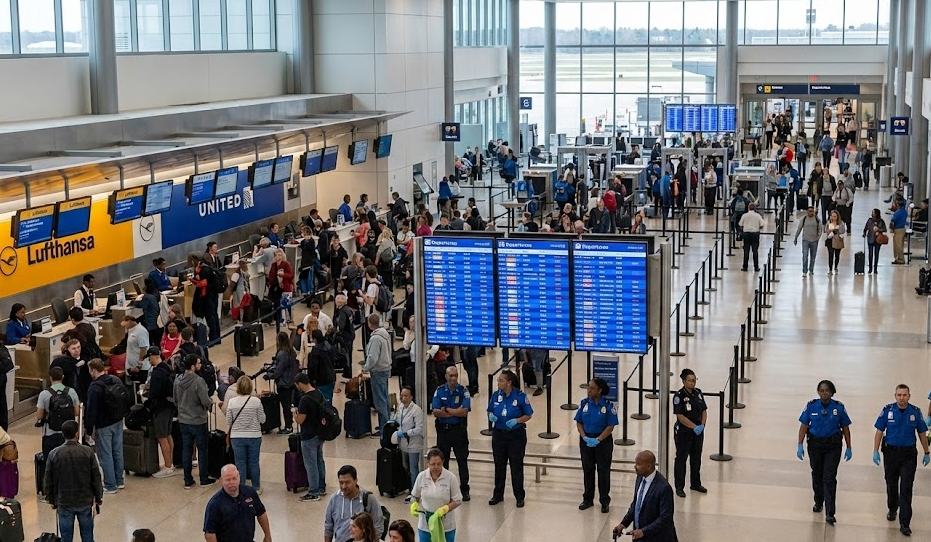
The reality of air travel is that no single organization controls the entire experience. The airline is responsible for reservations, check in, boarding, staffing the flight, and handling irregular operations. The airport manages the terminal space, the flow of people, the airside infrastructure, and key aspects of passenger processing. Government authorities control security screening and border checks. Ground handlers operate equipment, manage bags, and support the aircraft on the ramp. Technology vendors supply critical systems that link these processes together. Each of these actors is required for the journey to unfold. None can fully compensate when others face constraints.
Passengers do not see these boundaries. They only perceive the journey that emerges from their combined behavior. In this way, air travel mirrors many modern service environments in which experience is created by distributed systems rather than by isolated touchpoints. The difference in aviation is the pressure of time, regulation, and safety, which magnifies even minor inconsistencies into visible disruptions.
At the heart of experience in aviation lies the tension between operational complexity and passenger perception. Most travelers are not concerned with the intricacies of crew scheduling, aircraft rotation, baggage sortation logic, security lane management, or the algorithms that predict queue formation. They care far more about whether their process feels clear, whether their connection is secure, and whether they can trust the information they receive. In many situations, the emotional weight of the journey is shaped less by the events that take place and more by the sense of predictability the environment creates.
Clarity lightens passengers’ burden
Predictability is the central currency of the airport and airline experience. Travelers often arrive already in a heightened emotional state. They are managing time pressure, personal risk, planning for onward connections, and navigating an environment in which the rules may not be obvious. When the system provides clarity, the emotional burden lightens. When it obscures what is happening, or when contradicting signals appear, anxiety grows. This is why small misalignments often have disproportionate impact. A five minute delay at security can feel trivial if the reason is clear and the information consistent. The same delay can feel intolerable if communication is absent or contradictory.
To understand why predictability is so fragile in air travel, it is necessary to examine the nature of interdependence at airports. Nearly every process is dependent on information or actions from another actor. The airline depends on airport resource allocation for stands, gates, and check in counters. The airport depends on airlines and handlers for accurate flight data. Security depends on the airport for staffing inputs and on the airline for passenger volume forecasts. Baggage systems depend on the accuracy of load sheets and timing sequences from the ramp. Immigration depends on real time arrival patterns influenced by air traffic control decisions. These relationships form a dynamic network, not a linear chain. When one element deviates from expected behavior, the effects ripple outward across the system.

This interdependence is often invisible to the passenger, yet it shapes almost every step of their journey. A gate change may originate in a mismatch between aircraft size and stand allocation, even if the passenger assumes it is simply a disorganized process. A long queue at security may reflect earlier congestion in the airport access roads, yet the passenger experiences it as an airport failing in the present moment. A baggage delay might arise from upstream decisions about ground equipment, staffing redistribution, or flow control in the baggage hall, but to the traveler it manifests as a single, frustrating outcome.
When viewed from the inside, many of these disruptions appear entirely rational. When seen from the outside, they appear arbitrary. The gap between internal logic and external perception is one of the defining challenges in aviation. Each actor in the system is often doing exactly what their mandate requires, yet the collective outcome can feel disjointed when alignment falters. This is why customer experience in aviation cannot be managed solely through service design or hospitality training. These are important, but they operate on the surface of a much more intricate system.
System interactions shape the passengers’ perception
To improve the travel experience, organizations need a method for understanding how these systems interact and how their interactions shape passenger perception. It requires moving beyond touchpoints and examining the structures, flows, policies, and decision rights that govern the journey behind the scenes. It requires acknowledging that experience emerges from the behavior of the system, not just the behavior of individuals. It also requires deeper collaboration across functions and organizations, since no single actor can independently create a coherent journey.
One of the most powerful insights from studying airports and airlines is that most experience failures are not caused by lack of effort or lack of care. They stem from mismatches between how systems are designed and how passengers interpret the environment. These mismatches create what could be called experiential friction. They are small barriers or misalignments that accumulate until the journey feels unstable. Friction might appear in conflicting information from different sources. It might appear in unexpected procedural requirements that passengers did not anticipate. It might appear in inconsistent communication among employees whose internal systems show different versions of the truth. What matters to the traveler is not the origin of the friction but the feeling it creates.
When organizations begin to see the journey as a coherent system, the nature of improvement shifts. Instead of asking how to make a single touchpoint more pleasant, they begin to ask how information flows across the system, how decisions are made, and how responsibilities intersect. They examine how operational constraints influence emotional outcomes. They explore how technology can support, rather than complicate, collaboration across actors. They recognize that clarity is a system property and not an attribute of a single interaction.
Airports and airlines that adopt this perspective gain a new understanding of performance. They see that many visible problems originate far earlier in the timeline of the journey. A stressful boarding experience may begin with a mismatch between expected and actual passenger load. A missed connection may originate in an overly compressed ground schedule for an inbound aircraft. A congested security checkpoint may have roots in the lack of real time demand forecasting. With a systems lens, these patterns become easier to interpret and easier to influence.
This understanding also changes the nature of measurement. Traditional satisfaction metrics capture emotional response but seldom reveal the deeper mechanisms that shaped that response. In aviation, where variability has major consequences, measurement must shift toward understanding system behavior. Queue times, processing times, off block punctuality, transfer success rates, baggage delivery intervals, and communication latency all serve as indicators of how well the system is functioning. When these indicators are visible and connected, organizations can identify friction early and intervene before it becomes a visible disruption.
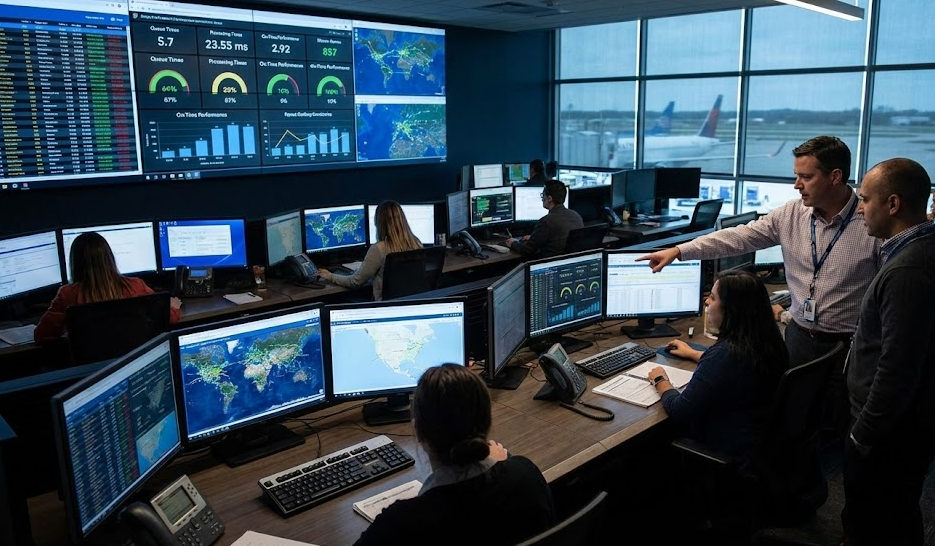
The future of passenger experience in airports and airlines lies in this ability to see, understand, and align the system that produces the journey. As travel volumes increase, as digital expectations evolve, and as operational environments become more constrained, the need for system level clarity becomes greater. The organizations that excel will be those that can synchronize their internal structures with the reality of the passenger journey, not as it appears in diagrams but as it unfolds in the lived environment.
Air travel will never be simple. It will always involve multiple actors, high operational stakes, regulatory oversight, and fluctuating conditions. But complexity does not need to translate into confusion or inconsistency. When the system is coherent, the experience becomes predictable. When the experience is predictable, passengers feel confident and informed. When passengers feel confident and informed, the emotional tone of the journey stabilizes. What emerges is not superficial delight but something far more valuable in aviation: trust.
Trust is built when systems behave in ways that travelers can understand and anticipate. It is reinforced when information is consistent, when processes align across actors, and when disruptions are explained with clarity rather than obscured by silence. In this sense, trust is not merely an emotional outcome but a structural one. It is the result of alignment, coordination, and transparency across the system.
As airports and airlines continue to evolve, the challenge is not only to modernize facilities or innovate digital tools. The deeper challenge is to operate the experience as a unified system that reflects the interdependent reality behind the scenes. When organizations commit to this approach, they unlock new possibilities for stability, efficiency, and long term improvement. More importantly, they create journeys that respect the emotional, cognitive, and practical needs of the people who travel through them.