
In most organizations, emotional experience is treated as a surface level concept. It is associated with politeness, friendliness, attentiveness, and interpersonal skill. Teams assume that if people smile, if the tone of voice is warm, and if interactions feel welcoming, then emotional outcomes will follow. This belief is understandable. In many low complexity environments, interpersonal behavior does play a measurable role in shaping satisfaction. The challenge is that most modern service environments do not operate at low complexity anymore. They operate through intricate systems composed of interdependent processes, distributed teams, constrained resources, overlapping decision rights, and continuous flow. These systems shape the emotional landscape long before any employee speaks to a customer.
When journeys involve uncertainty, dependency, or risk, emotion behaves differently. It is not shaped primarily by the quality of interpersonal interactions. It is shaped by the predictability of the system. Predictability reassures. Unpredictability destabilizes. A warm smile can take the edge off a moment, but it cannot overcome structural inconsistency. A perfectly designed interface may look elegant, but if the system behind it behaves unpredictably, the emotional outcome will still be one of tension or doubt. In complex environments, the emotional experience is a product of the system, not the touchpoint.
Consider the experience of a passenger moving through an airport, a patient admitted to a hospital, a commuter navigating a public transport

disruption, a customer undergoing identity verification in a financial institution, or a household dealing with an energy outage. In each scenario, the individual is operating inside a system that holds more information than they do. They must interpret signals, rules, timings, and behaviors without full visibility of what is happening. The emotional state they experience is determined by whether those signals create clarity or confusion. If the system behaves predictably, the uncertainty they feel reduces. If it behaves unpredictably, emotional pressure rises regardless of how courteous the people around them are.
Predictability functions as the foundation of emotional stability. People feel more at ease when they know what will happen next, why something is happening, how long it will take, and what their role is in the process. This is true even when the journey is constrained or stressful. A difficult medical procedure feels different when the sequence is clear. A delayed flight feels different when the cause is transparent. A verification process in a bank feels different when the reasoning is explained plainly. Emotional stability arises not from the absence of difficulty but from the presence of clarity. This clarity acts as a stabilizing force that reduces cognitive load and lowers anxiety.
Most emotional instability in complex journeys does not arise from interpersonal behavior. It arises from gaps in system behavior. These gaps appear when communication is inconsistent, when decisions change without explanation, when information does not align across channels, or when processes operate in ways that contradict the signals people receive. The individual is left to fill the gaps with assumptions, often negative ones, because in uncertain conditions the human mind tends to anticipate risk. The emotional consequence is rarely anger first. It is confusion. Confusion then transforms into concern or distrust when the ambiguity persists.
In many organizations, frontline staff are expected to compensate for these gaps. They are asked to be reassuring, patient, empathetic, and supportive, yet they often operate in environments where the system provides them with limited information or contradictory guidance. They may not know why a delay occurred, why a rule has changed, or why a particular process is behaving differently today compared to yesterday. This lack of systemic clarity places emotional labor on employees that should not belong to them. Emotional reliability requires system reliability. When the system is inconsistent, staff can only respond situationally, and situational reassurance seldom produces durable emotional stability for customers.
If we examine the emotional experience of high complexity environments more closely, a pattern emerges. Emotional peaks and dips correlate strongly with moments in which the system either reinforces or undermines the individual’s sense of orientation. A passenger who understands the sequence of airport processing feels calmer even when queues are long. A patient who understands what will happen in the next hour feels more grounded even when the procedure is serious. A commuter who receives early, accurate information about a service disruption feels more capable of making decisions. The emotional meaning of an event is shaped less by the event itself and more by the clarity of the surrounding context.
This reveals an important truth. Emotional experience in complex environments is not a soft layer. It is a structural outcome. It emerges from how processes are designed, how information flows, how decisions are communicated, and how responsibilities are distributed across functions. When these elements align, emotional stability becomes a natural byproduct of system behavior. When they misalign, instability emerges even if individual touchpoints are well executed.
Predictability functions as a form of emotional governance. It signals to people that the environment is under control, that risks are being managed, and that the system behaves in a way they can understand. Once predictability is established, other forms of positive emotion become possible. People can appreciate courtesy when the system is stable. They can value hospitality when the environment feels coherent. Without stability, these qualities struggle to penetrate the emotional noise created by uncertainty.
This principle extends far beyond airports or transport environments. In healthcare, emotional tension increases when patients do not understand what will happen next or why plans keep changing. In utilities, emotional instability arises when households receive conflicting information during outages. In financial services, emotion is shaped by whether verification and decision processes behave consistently. In retail, particularly in omnichannel journeys, the emotional tone depends on whether the handover between channels feels seamless. In public sector services, emotional stability is often a function of whether procedures are transparent and consistent across different offices or digital platforms.
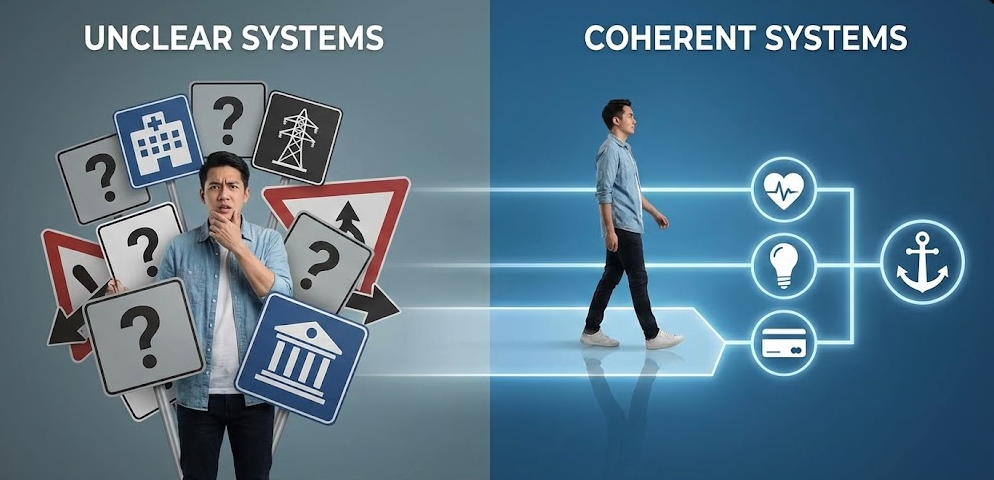
In all these environments, the role of emotion is tied to system behavior. When organizations treat emotional outcomes as interpersonal issues, they overlook the deeper mechanisms that generate them. Hospitality can improve surface level experience, but it cannot compensate for structural gaps. Emotional reliability requires clarity of process, alignment of information, consistency of decision logic, and stability of outcomes across channels and teams.
When organizations begin to view emotion as an emergent property of system design, a different type of improvement becomes possible. Instead of focusing exclusively on what customers see or feel in a moment, they examine the structures that create those feelings. They look at how information moves, how expectations are set, how transitions between functions operate, how exceptions are handled, and how transparency is maintained. They observe how customers interpret signals and how those signals influence confidence. They begin to understand that emotional experience depends on environmental predictability far more than on episodic delight.
This perspective reframes the traditional idea of emotional engagement. Delight, surprise, and friendliness still have value, but they sit atop a more fundamental requirement. The system must behave predictably. When predictability is present, customers can extend trust to the organization. They can cooperate with processes more easily. They can navigate complexity with less emotional strain. When predictability is absent, even the most polished service interactions feel insufficient because the environment itself signals instability.
The strategic opportunity lies in designing for emotional stability first. This does not require creating perfect journeys. It requires creating coherent ones. It requires ensuring that customers understand what is happening, that communication is consistent, that transitions between functions are smooth, and that decisions feel proportional and fair. It requires aligning operations with the emotional reality of the people they serve. When organizations do this, they not only reduce friction but also strengthen trust, which is the foundation of any long term relationship.
In complex systems, emotion is not a byproduct. It is an indicator of system health. Stable emotional experience reveals coherent system behavior. Unstable emotional experience reveals fragmentation. The more complex the environment, the more important this connection becomes. Predictability does not eliminate the challenges of service delivery, but it transforms how those challenges are understood and felt by customers.
As organizations continue to operate in increasingly interconnected and time sensitive contexts, the ability to create emotional stability through system clarity will determine their capacity to build trust and maintain resilience. The future of customer experience is not primarily about creating moments of delight. It is about designing systems that behave in ways people can understand. When the system becomes predictable, the emotional landscape transforms. Confidence grows. Anxiety reduces. Trust becomes possible. And once trust is present, everything else becomes easier to deliver.